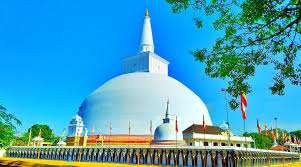
The Ruwanweli Maha Seya, also known as the Maha Thupa (lit. 'the Great Thupa'), is a stupa (a hemispherical structure containing relics) in Anuradhapura, Sri Lanka. Two quarts or one Dona of the Buddha's relics are enshrined in the stupa, making it the largest collection of his relics anywhere.It was built by Sinhalese King Dutugemunu in c. 140 B.C., who became king of Sri Lanka after a war in which the Chola King Elāra (Ellalan) was defeated. It is also known as Swarnamali Seya, Svaṇṇamāli Mahaceti (in Pali) and Rathnamali Seya.
This is one of the "Solosmasthana" (the 16 places of veneration) and the "Atamasthana" (the 8 places of veneration). The stupa is one of the world's tallest ancient monuments, standing at 103 m (338 ft) and with a circumference of 290 m (951 ft). The original stupa had been about 55 m (180 ft) in height and was renovated by many kings. The Kaunghmudaw Pagoda in Sagaing, Myanmar is modelled after this stupa The Mahavamsa contains a detailed account on the construction and the opening ceremony of the stupa.
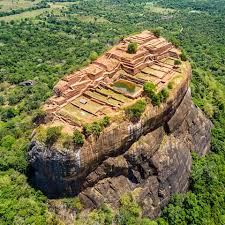
ancient rock fortress located in the northern Matale District near the town of Dambulla in the Central Province, Sri Lanka. It is a site of historical and archaeological significance that is dominated by a massive column of granite approximately 180 m (590 ft) high. According to the ancient Sri Lankan chronicle the Cūḷavaṃsa, this area was a large forest, then after storms and landslides it became a hill and was selected by King Kashyapa (CE 477–495) for his new capital. He built his palace on top of this rock and decorated its sides with colourful frescoes. On a small plateau about halfway up the side of this rock he built a gateway in the form of an enormous lion. The name of this place is derived from this structure; Sinhagiri, the Lion Rock. The capital and the royal palace were abandoned after the king's death. It was used as a Buddhist monastery until the 14th century. Sigiriya today is a UNESCO listed World Heritage Site. It is one of the best preserved examples of ancient urban planning.
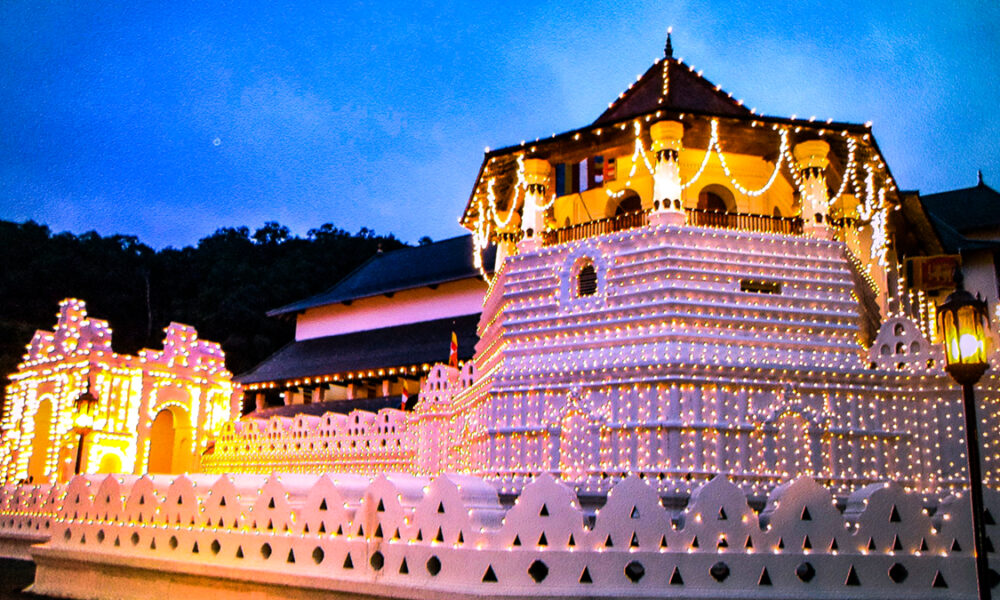
Sri Dalada Maligawa, commonly known in English as the Temple of the Sacred Tooth Relic, is a Buddhist temple in Kandy, Sri Lanka. It is located in the Royal Palace Complex of the former Kingdom of Kandy, which houses the relic of the tooth of the Buddha. Since ancient times, the relic has played an important role in local politics because it is believed that whoever holds the relic holds the governance of the country. The relic was historically held by Sinhalese kings. The Temple of the Tooth is a World Heritage Site mainly due to the temple and the relic. Bhikkhus of two particular chapters, the Malwathu chapter and the Asgiri chapter, conduct daily worship in the inner chamber of the temple. Rituals are performed three times daily: at dawn, at noon and in the evenings. On Wednesdays, there is a symbolic bathing of the relic with a herbal preparation made from scented water and fragrant flowers called Nanumura Mangallaya; this holy water is believed to contain healing powers and is distributed to those present. The Kandy Esala Perahera, is conducted annually to pay homage to the Sacred Tooth Relic.
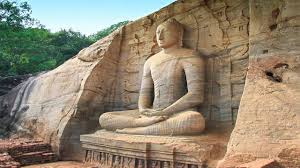
The four sites of the Buddha statues of the Gal Vihara are called “caves”, though the three huge ones are not posted below rock sheltered but sculptured in partly artificial rock niches, except from the one small Buddha image seated in a cave indeed. The Gal Vihara rock measures 52 m (170 ft) in length, Along the 26 m long centrepiece, the rock is 10 m high, it then falls away gradually towards each end. Sockets cut into the rock just behind the statues indicate that the walls had originally separated the statue from one another. Accordingly, remnants of brick foundations walls testify that each of the four figures was enshrined in a separate image house. The images were not intended to decorate a rock surface picturesquely but to be venerated inside shrine rooms, three of them with vaulted brick walls. Those “cave rooms” were only illuminated by small windows and candle light. This means, originally the immense statues were not exposed to sunshine as today. The figures were once plastered and painted in the same manner as other images in Sri Lanka’s cave temples.